

The International Brain Education Association (IBREA), in collaboration with Global Cyber University, the University of Brain Education, and the IBE Graduate School in the United States, successfully hosted “Earth Management Roundtable: The Second Chapter” via Zoom Live on November 26.
Held under the theme “Reimagining the Coexistence of Humanity and Technology in the AI Era,” the forum moved beyond conventional discussions centered on regulation and ethics. Instead, it highlighted the importance of strengthening humans’ internal senses and intrapersonal competencies—such as sensory awareness, emotional regulation, attention, and self-regulation—which are core factors shaping the direction of technology.
Professor Kwang-Ho Seok: “AI, Hope Beyond Fear — Pathways to AI for Coexistence”
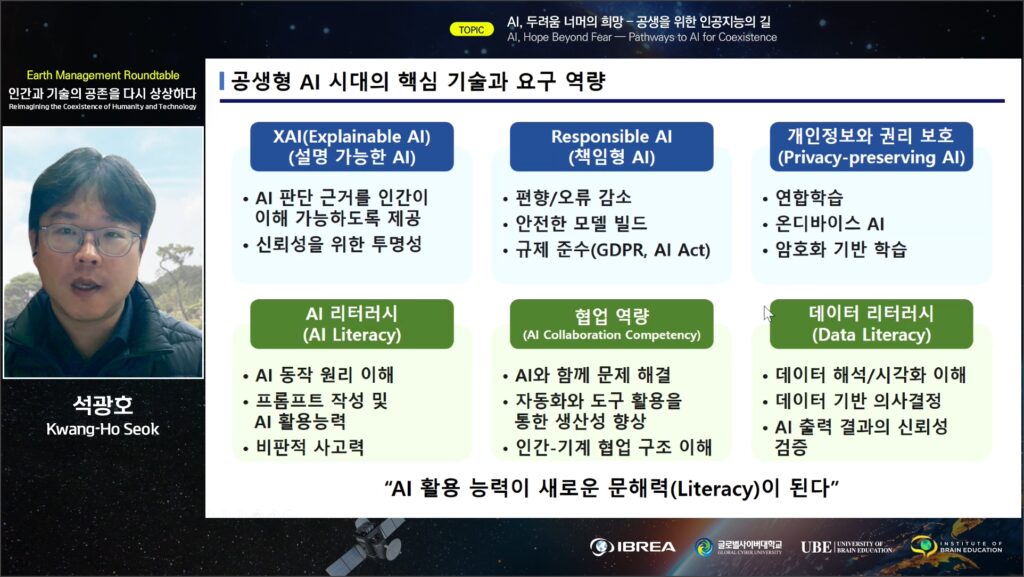
Opening the session, Prof. Kwang-Ho Seok, Director of the School of AI Convergence at Global Cyber University, emphasized that although rapid technological diffusion has intensified public anxiety, AI remains an instrumental technology that operates within the purpose and scope designed by humans.
He introduced key technologies essential to steering AI toward coexistence—such as explainable AI (XAI), responsible AI, privacy-preserving technologies, and federated learning. He also stressed the need for humans to strengthen their AI utilization capacities, including AI/data literacy and human–machine collaboration skills.
Director Steve Kim: “Intelligence as a Natural Principle and the Coevolution of Humans and AI”
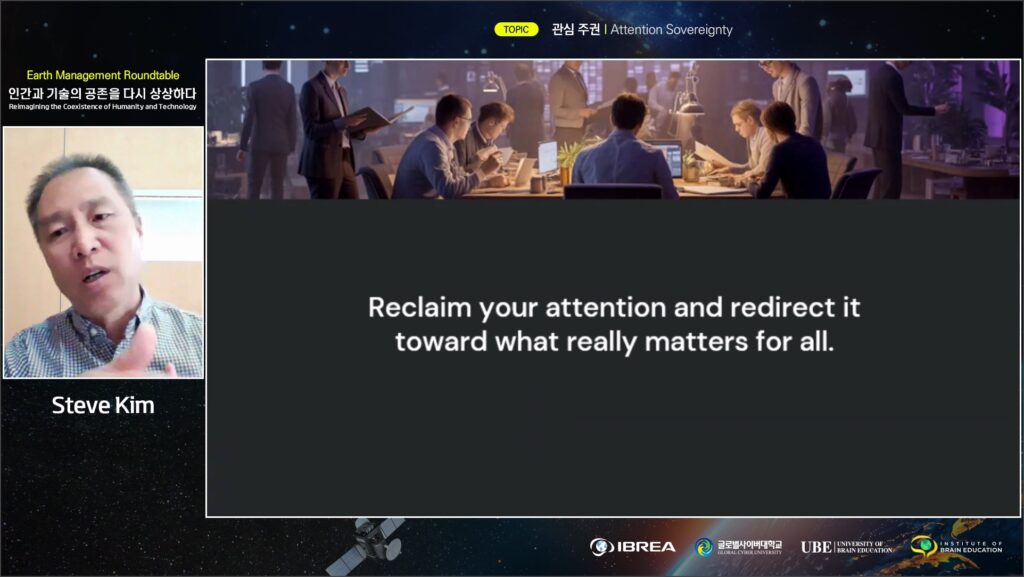
In the second presentation, Steve Kim, Director of ECO (Earth Citizens Organization), argued that intelligence should be understood as a natural principle—a phenomenon that emerges whenever conditions such as complexity, connectivity, and information flow reach a certain threshold.
From this perspective, recent advances in AI represent not a fundamentally different form of intelligence but another manifestation of the same principle expressed through a different medium. Human brains and AI systems differ in structure, he noted, yet both exhibit intelligence because they meet the underlying conditions that allow intelligent behavior to emerge.
He therefore proposed viewing the relationship between humans and AI not as opposition but as coevolution. What ultimately shapes the direction of AI, Kim emphasized, is the values and patterns of attention humans choose and continually reinforce—a concept he described as “attention sovereignty.”
Professor Rae Hyuk Chang: “Natural Intelligence and Self-Regulation in the Human Brain”
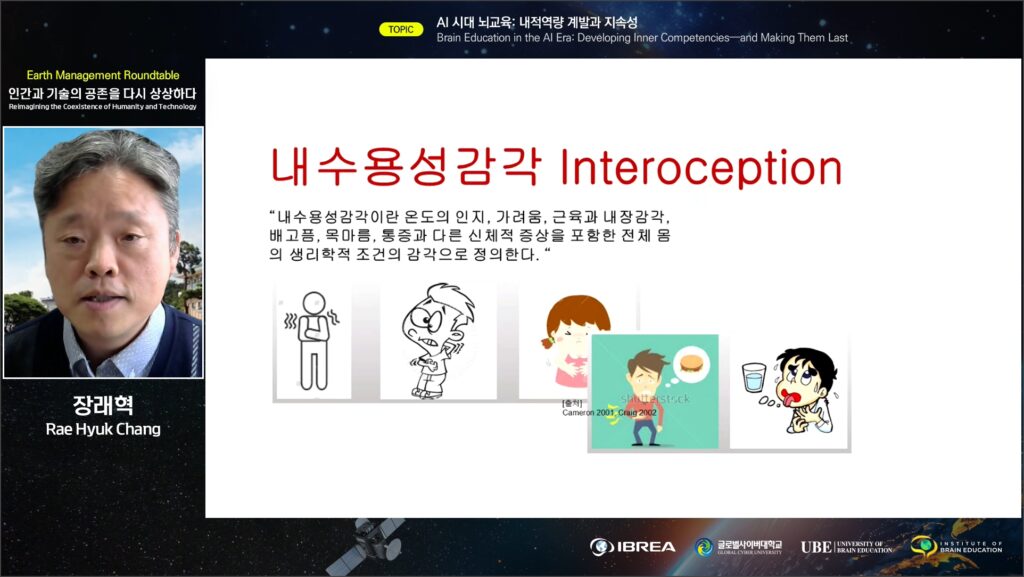
Prof. Rae Hyuk Chang of the Brain Education Department at Global Cyber University stressed that current AI represents a narrow form of artificial intelligence specialized in specific functions, underscoring the importance of redefining humans’ unique capabilities.
He explained that the human brain possesses natural intelligence capable of regulating emotion and behavior based on bodily senses—particularly interoception (the internal sense of the body). Such capacities, he noted, are difficult to sustain through one-off training; instead, continuous reinforcement is required through a community environment that encourages shared experience and mutual support.
Introducing the online platform “ZERO,” framed as an “Energy Charging Station for Earth Citizens,” he explained how regular participation and collective practice help strengthen self-regulation over time.
Panel Discussion: Restoring Human-Centeredness and Expanding Our Perspective
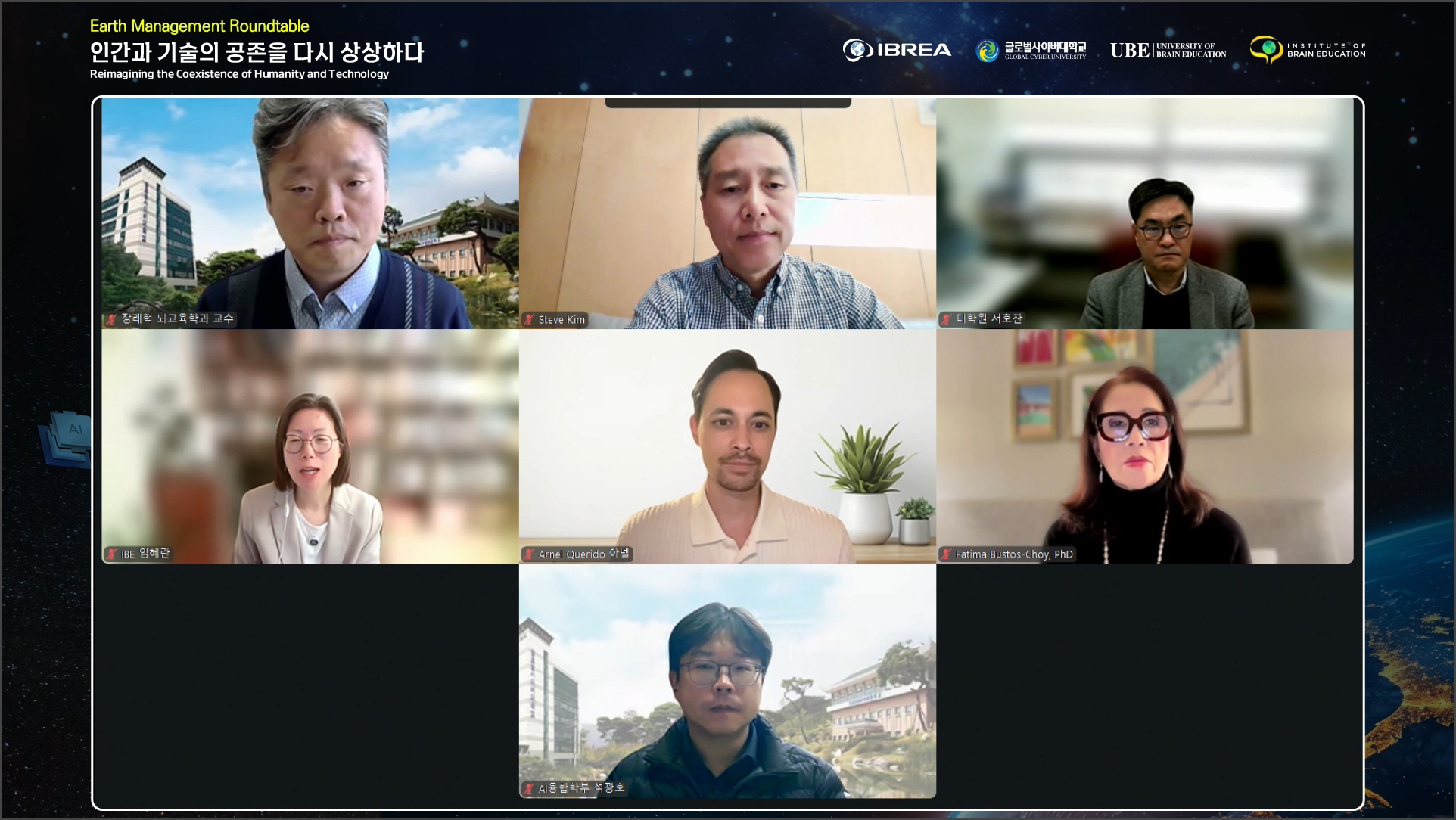
During the panel session, Dr. Fatima Bustos-Choy of the IBE Graduate School highlighted that while technology is evolving rapidly, human emotional resilience, attention, and mental well-being are becoming increasingly fragile. Addressing rising burnout and isolation in organizations and educational settings, she emphasized that Brain Education professionals play a critical role in helping individuals regulate emotions, manage attention, and restore balance—an essential foundation for reaffirming human value in a technology-driven society.
Arnel Querido, a master’s student at the IBE Graduate School, shared that the so-called “overview effect”—a shift in consciousness astronauts experience when seeing Earth as a single living community—can naturally emerge inwardly through Brain Education without going into space. He described Earth Management studies as a field that enables more people to access this expanded perception and panoramic awareness. He also noted that studying Earth Management has helped him see not only the risks of AI but also the greater potential of human beings.